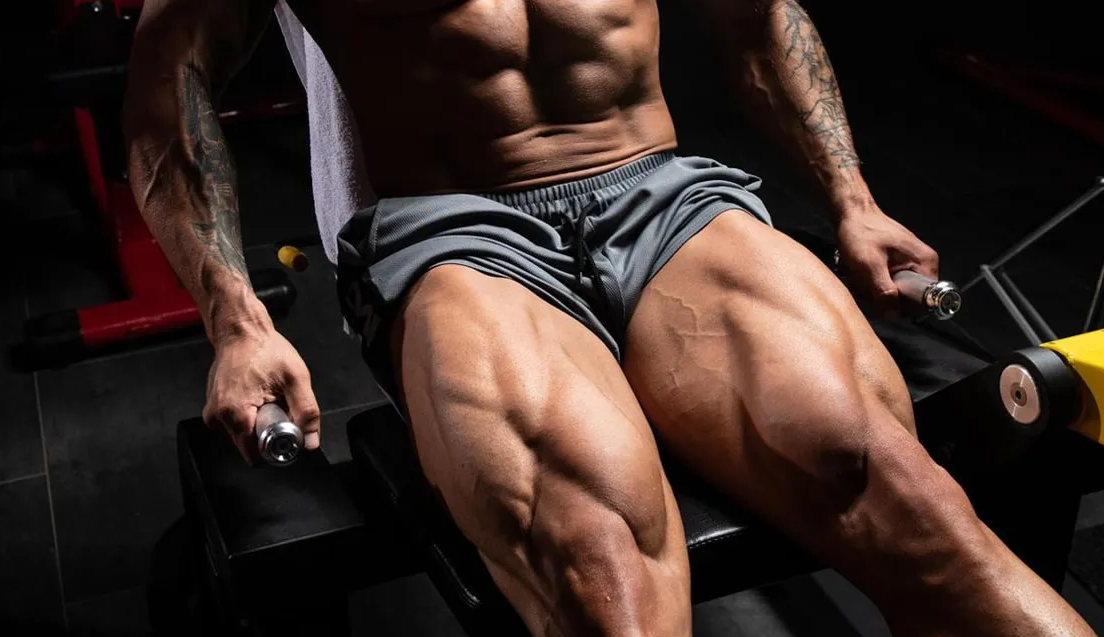
The quadriceps form much of the muscle mass at the front of the thigh and play a central role in knee movement. They straighten the leg, control movement during walking and running, and help absorb force when landing from a jump. Everyday activities, from climbing stairs to getting out of a chair, also depend on these powerful muscles.
Although commonly described as a single muscle, the quadriceps consist of four interconnected muscles. All contribute to knee extension, but their anatomical positions and mechanical roles differ. One also crosses the hip joint, allowing it to assist with hip flexion.
Building stronger quadriceps involves more than lifting heavier weights. Exercise selection, range of motion, training volume, and recovery all influence strength and muscle growth. Understanding how these muscles work makes it easier to train them effectively while managing the demands placed on the knees.
What Are the Quadriceps?
The quadriceps femoris, commonly called the quads, is a large muscle group covering the front of the thigh. Its name comes from the Latin term for “four-headed,” referring to its four main components.
The four quadriceps muscles are:
- Rectus femoris: Runs along the center of the thigh and crosses both the hip and knee joints.
- Vastus lateralis: Occupies much of the outer thigh and contributes substantial knee-extension force.
- Vastus medialis: Lies along the inner thigh, forming the recognizable teardrop shape above the knee.
- Vastus intermedius: Sits beneath the rectus femoris, against the front of the femur.
These quad muscles join through the quadriceps tendon, which attaches to the patella, or kneecap. Force passes through the patella and patellar ligament to the tibia, allowing the knee to straighten.
Among the body’s largest and strongest muscle groups, the quadriceps handle considerable demands during weight-bearing activities. Their shared attachment creates a coordinated knee-extension mechanism, while differences in their origins influence how each muscle contributes to movement.
Anatomy of the Four Quadriceps Muscles
Understanding quadriceps anatomy starts with a key distinction: three muscles originate on the femur, while the rectus femoris attaches to the pelvis. This explains why hip position affects the rectus femoris differently from the other three muscles.
Rectus Femoris
The rectus femoris runs down the center of the anterior thigh, covering much of the vastus intermedius. Unlike the other quadriceps muscles, it crosses two joints.
Its proximal attachments include the anterior inferior iliac spine and the region immediately above the hip socket. From the pelvis, it travels down the thigh and joins the common quadriceps tendon.
The rectus femoris performs two actions: knee extension and hip flexion. It helps bring the thigh toward the torso during running and kicking while also contributing to straightening the knee.
Its two-joint structure influences force production. When the hip is flexed and the knee is extended, the muscle shortens across both joints. This can reduce its ability to produce active force, a phenomenon known as active insufficiency.
Vastus Lateralis
The vastus lateralis occupies much of the outer thigh and is typically the largest quadriceps muscle by volume.
It originates from several areas of the femur, including the greater trochanter and lateral lip of the linea aspera. Its fibers descend toward the quadriceps tendon and structures surrounding the outer portion of the patella.
The vastus lateralis generates substantial knee-extension force during squats, cycling, stair climbing, and jumping. It also contributes to the lateral forces acting on the kneecap.
However, patellar tracking depends on the combined influence of the quadriceps, surrounding connective tissues, and individual joint anatomy rather than any single muscle.
Vastus Medialis
The vastus medialis lies along the inner thigh. Its lower fibers form the distinctive teardrop-shaped contour above the inside of the knee.
The muscle originates from the femur, including portions of the intertrochanteric line and medial lip of the linea aspera.
Alongside knee extension, the vastus medialis contributes to the forces influencing patellar movement. Its lower, obliquely oriented fibers are often called the vastus medialis oblique, or VMO.
The VMO describes a region of the vastus medialis rather than a universally recognized separate muscle. Although exercise technique can affect regional activation, no reliable method has been established for training the VMO independently of the rest of the muscle.
Vastus Intermedius
The vastus intermedius sits beneath the rectus femoris, directly against the anterior and lateral surfaces of the femur.
It originates from the upper portions of the femoral shaft and joins the quadriceps tendon near the knee.
Because it crosses only the knee joint, hip position does not directly change its length in the same way it affects the rectus femoris.
Although largely hidden beneath other muscles, the vastus intermedius contributes to knee-extension force during both dynamic movements and sustained contractions.
What Do the Quadriceps Muscles Do?
The primary quadriceps function is knee extension, but these muscles also control knee bending, support weight-bearing activities, and influence forces acting through the joint.
Knee Extension
Knee extension occurs when the angle between the thigh and lower leg increases. The quadriceps produce this movement when standing from a chair, rising from a squat, or straightening the leg against resistance.
In an open-chain exercise such as a seated leg extension, the lower leg moves while the thigh remains relatively stationary.
In a closed-chain exercise such as a squat, the feet stay planted while the quadriceps help raise the body. Both train the knee extensors, although differences in joint position and resistance change how the muscles are loaded.
Controlling Knee Flexion
The quadriceps also control how quickly the knee bends.
During the lowering phase of a squat, they contract eccentrically, producing force while lengthening. This slows the descent rather than allowing the body to drop under gravity.
The same mechanism helps control movement when descending stairs, walking downhill, or landing after a jump. Eccentric strength is particularly important when the legs must absorb force and slow the body.
Hip Flexion
The rectus femoris assists other hip flexors in bringing the thigh forward. This contributes to movements such as sprinting, kicking, and stepping over obstacles.
The vastus lateralis, medialis, and intermedius originate on the femur and do not directly produce hip flexion.
Knee Stability and Load Management
Strong quadriceps improve the ability to control knee movement during demanding activities.
They regulate knee flexion and extension while contributing to the forces transmitted through the patellofemoral joint, where the kneecap meets the femur.
Greater strength can improve movement control and physical capacity, but it does not guarantee protection against injury. Coordination, training load, tendon capacity, and the condition of other knee structures also matter.
Why Strong Quadriceps Matter in Sports
Athletic performance frequently depends on the ability to produce force, absorb impact, and change direction. The quadriceps contribute to each of these tasks, although their involvement varies between sports.
Sprinting and Running
During running, the quadriceps help support the body and control knee motion when the foot contacts the ground.
In early stance, they regulate knee flexion as the leg absorbs impact. Their contribution changes with running speed, technique, and acceleration demands.
Quadriceps strength helps athletes handle the repeated braking forces involved in sprinting and deceleration. Running performance also depends on the glutes, hamstrings, calves, and coordination between muscle groups.
Jumping and Landing
Jumping requires coordinated extension of the hips, knees, and ankles.
The quadriceps provide knee-extension force during takeoff, working with the glutes and calf muscles to propel the body upward.
On landing, they help control knee bending and absorb mechanical energy. Fatigue or inadequate strength can make repeated landings harder to manage, particularly in sports involving frequent jumps.
Cycling
Cycling repeatedly loads the knee extensors, especially during the power-producing portion of the pedal stroke.
The quadriceps contribute to pushing the pedals downward, although their involvement changes with crank position, cadence, resistance, and riding technique.
Steep climbs and high-resistance efforts generally require greater force production than easy spinning at a similar cadence.
Cutting and Changing Direction
Basketball, soccer, tennis, and other multidirectional sports demand rapid deceleration followed by acceleration in a different direction.
The quadriceps help control knee bending during braking and contribute to the subsequent push-off.
Effective changes of direction also depend on hip strength, trunk control, balance, and foot placement. Strong quadriceps support these movements but cannot compensate for poor coordination.
Everyday Physical Function
Quadriceps strength matters beyond competitive sports.
Getting out of a low chair, carrying groceries upstairs, and descending a slope all require controlled knee movement.
For older adults, maintaining strength becomes particularly important as age-related declines in muscle mass can make routine activities more difficult. Resistance training helps preserve the physical capacity needed for independent movement.
Best Exercises to Strengthen the Quadriceps
Effective quadriceps training combines progressive resistance with exercises that challenge the knee extensors in different positions.
Squats and leg presses allow substantial loading, single-leg exercises develop strength and control on each side, and leg extensions provide more direct knee-extensor work.
Exercise selection depends on experience, available equipment, mobility, and how the knees respond to different movements.
Squats
Squats train the quadriceps alongside the glutes and other lower-body muscles. During the descent, the quadriceps control knee bending. During the ascent, they help straighten the knees and raise the body.
How to perform:
- Stand with your feet approximately shoulder-width apart.
- Brace your core and bend at the hips and knees.
- Lower as far as you can while maintaining balance and control.
- Push through your feet to return to standing.
Allowing the knees to move forward past the toes is not inherently unsafe. Appropriate knee travel depends on anatomy, mobility, and technique.
A more upright torso and greater knee flexion can increase the relative demand on the quadriceps. Heel-elevated squats may help some lifters achieve these positions, particularly when ankle mobility limits squat depth.
Bulgarian Split Squats
Bulgarian split squats challenge the front leg while the rear foot rests on an elevated surface. The movement also develops balance and hip stability.
How to perform:
- Stand in front of a stable bench or platform.
- Place the top of your rear foot on the support.
- Bend the front knee and hip to lower your body.
- Push through the front foot to return to the starting position.
Keeping the torso relatively upright and allowing comfortable forward knee travel can increase the emphasis on the front-leg quadriceps.
Beginners may find regular split squats easier to control before progressing to the rear-foot-elevated version.
Leg Press
The leg press allows the quadriceps to work against substantial resistance without the balance demands of a free-weight squat.
It is useful for developing knee-extension strength and muscle size, particularly when additional training volume is needed.
How to perform:
- Sit with your back and pelvis supported.
- Place your feet comfortably on the platform.
- Bend your knees to lower the weight while keeping your pelvis stable.
- Push the platform away, extending your knees smoothly without snapping into hyperextension.
Use a range of motion that allows your pelvis to remain supported. Lowering the platform too far can cause the lower back to round or the hips to lift.
Foot placement changes movement mechanics, but minor adjustments do not reliably isolate individual quadriceps muscles.
Leg Extensions
Seated leg extensions train the quadriceps by moving the lower leg against resistance.
Unlike squats and leg presses, they do not require substantial hip extension, making them useful for adding direct knee-extensor work.
How to perform:
- Adjust the machine so its pivot aligns approximately with your knee joint.
- Position the resistance pad near the lower shin.
- Straighten your knees through a comfortable range of motion.
- Lower the weight under control without swinging.
Leg extensions can support quadriceps growth and strength development, especially when combined with compound exercises.
They are not inherently harmful to healthy knees. However, joint forces vary throughout the movement, and people recovering from certain knee injuries or surgeries may require specific restrictions.
Step-Ups
Step-ups strengthen the quadriceps while resembling stair climbing and other daily activities. They also develop single-leg coordination and involve the hip extensors.
How to perform:
- Stand in front of a stable platform.
- Place one foot fully on top.
- Push through the elevated foot to raise your body.
- Lower slowly and repeat.
A higher platform generally requires greater knee and hip flexion, increasing the movement’s demands.
Choose a height that allows the working leg to perform most of the effort without a strong push from the trailing foot.
How to Structure Quadriceps Training
Training the quadriceps two or three times per week works well for many recreational lifters, provided total weekly volume and recovery are managed appropriately.
A practical workout can combine a compound movement, a single-leg exercise, and a leg extension. Beginners may need fewer exercises or sets.
Example quadriceps workout
| Exercise | Sets | Repetitions |
| Squat | 3 | 6–10 |
| Bulgarian split squat | 3 | 8–12 per leg |
| Leg extension | 2–3 | 10–15 |
These repetition ranges are examples rather than strict requirements. Both lighter and heavier weights can build muscle when sets are sufficiently challenging.
Finishing most working sets with roughly one to three repetitions in reserve is one way to manage intensity without consistently training to failure.
Increase resistance gradually as technique and performance improve, allowing sufficient recovery between demanding sessions.
How to Stretch the Quadriceps Safely
Quadriceps stretching involves bending the knee, often combined with hip extension to increase the stretch on the rectus femoris.
Regular stretching can improve range of motion and temporarily relieve feelings of tightness. However, tightness does not necessarily mean a muscle has become structurally shorter.
Standing Quadriceps Stretch
The standing quad stretch requires no equipment, although holding a stable surface helps with balance.
- Stand upright and hold a wall or chair for support.
- Bend one knee and grasp the ankle behind your body.
- Gently bring the heel toward the buttock.
- Keep your pelvis controlled without excessively arching your lower back.
- Hold for 20–30 seconds, then switch legs.
Avoid pulling aggressively on the ankle. You should feel manageable tension along the front of the thigh rather than sharp knee pain.
Side-Lying Quadriceps Stretch
This variation removes the balance demands of standing.
Lie on one side, bend the upper knee, and hold the ankle behind your body. Gently draw the thigh backward while keeping the pelvis stable.
A strap can make the movement more comfortable if reaching the ankle is difficult.
Half-Kneeling Rectus Femoris Stretch
A standard half-kneeling hip-flexor stretch emphasizes hip extension. Adding knee flexion increases the stretch placed on the rectus femoris, which crosses both joints.
Place one knee on a padded surface with the opposite foot in front. Gently tuck your pelvis to limit lower-back arching.
Gradually bend the rear knee while maintaining hip extension. The rear foot can rest against a wall or be supported with a strap.
Start gently and avoid forcing the knee into an uncomfortable position.
When Should You Stretch?
Dynamic movements are generally better suited to warm-ups before sprinting, jumping, or heavy strength training.
Controlled leg swings, bodyweight squats, and progressively heavier warm-up sets prepare the legs for demanding movement.
Static quadriceps stretches fit well after exercise or during separate mobility sessions.
Prolonged, intense static stretching immediately before explosive activity can temporarily reduce force production, particularly without subsequent dynamic preparation.
Stretching is not a reliable method for preventing delayed-onset muscle soreness. Appropriate training loads and recovery remain important.
Common Quadriceps Problems and Injury Prevention
Pain in the front of the thigh or around the knee can have several causes, including muscle strains, tendon problems, and conditions affecting nearby joint structures.
The location of pain, how it begins, and which movements aggravate it can help distinguish between these problems.
Quadriceps Strains
A quadriceps strain occurs when muscle fibers are injured by excessive force or stretch.
The rectus femoris is particularly vulnerable during high-speed activities because it crosses both the hip and knee joints. Sprinting and kicking are common injury mechanisms.
Symptoms may include sudden thigh pain, tenderness, weakness, swelling, or bruising. Severe strains can make walking or actively straightening the knee difficult.
Recovery depends on injury severity. Returning to intense activity before strength and function have recovered increases the risk of another injury.
Quadriceps Tendinopathy
Quadriceps tendinopathy affects the tendon connecting the quadriceps to the kneecap.
It is often associated with repeated loading and insufficient adaptation to training demands, although several factors can influence its development.
Pain typically occurs just above the patella and may become more noticeable during squatting, jumping, or forceful knee extension.
Management generally involves modifying aggravating activities and gradually rebuilding tendon capacity through progressive exercise.
Complete rest is not always necessary, but persistent symptoms should be assessed by a qualified healthcare professional.
Patellofemoral Pain
Patellofemoral pain causes discomfort around or behind the kneecap.
It commonly becomes noticeable during stair climbing, squatting, running, or prolonged sitting.
Several factors can contribute, including training load, lower-limb mechanics, hip and quadriceps strength, and individual pain sensitivity.
Patellofemoral pain cannot be explained solely by VMO weakness or changes in patellar tracking.
Exercise-based management often combines progressive knee and hip strengthening with adjustments to activities that aggravate symptoms.
Quadriceps Tendon Rupture
A quadriceps tendon rupture involves partial or complete tearing of the tendon above the kneecap.
A complete rupture can prevent active knee extension and make it difficult or impossible to raise the straightened leg while lying down.
Sudden pain, substantial swelling, or an inability to straighten the knee after an injury requires urgent medical evaluation.
Reducing Injury Risk
No training program can eliminate injury risk, but several practices help muscles and tendons tolerate physical demands.
- Progressive loading: Increase resistance, training volume, and high-speed activity gradually.
- Adequate recovery: Allow time between demanding sessions, particularly when fatigue affects performance.
- Movement preparation: Warm up progressively toward the speed and intensity of the planned activity.
- Balanced strength training: Develop the quadriceps alongside the hamstrings, glutes, and calves.
- Sport-specific preparation: Practice sprinting, landing, and changing direction when these movements are required in competition.
Pain that persists, worsens, or changes normal movement should not be ignored.
After a significant injury, returning to sport should depend on restored strength, movement control, symptoms, and the ability to meet sport-specific demands rather than a fixed number of rest days.
FAQ
Are the quadriceps one muscle or four?
The quadriceps femoris consists of four main muscles: rectus femoris, vastus lateralis, vastus medialis, and vastus intermedius. All contribute to knee extension, while the rectus femoris also assists with hip flexion.
What is the best exercise for quadriceps growth?
Squats, leg presses, split squats, and leg extensions can all build quadriceps muscle. The best choice depends on range of motion, training effort, and progressive resistance. Combining compound movements with leg extensions is a practical approach.
Can you train quadriceps every day?
Light quadriceps activity can be performed daily, but demanding resistance sessions usually require recovery. Training hard every day may lead to accumulated fatigue and reduced performance. Two or three challenging sessions per week are sufficient for many recreational lifters.
Do squats work all four quadriceps muscles?
Yes. All four muscles contribute to knee extension during squats, although their relative activity varies with joint angles, technique, and individual anatomy. Squats also involve the glutes and other supporting muscles.
Why do my quadriceps feel tight after exercise?
Tightness may result from fatigue, unfamiliar exercise, delayed-onset muscle soreness, or temporary changes in movement tolerance. It does not necessarily indicate that the muscles have shortened. Gentle movement and appropriate recovery may help, while persistent pain or significant loss of function warrants medical assessment.