Coordination affects nearly every aspect of athletic performance, from catching a baseball to controlling body position during a gymnastics routine. It helps athletes time their movements, adjust to changing conditions, and perform complex skills accurately. A well-coordinated athlete can combine several actions into one fluid movement, even when speed or pressure increases.
Coordination is not simply an inborn talent. Athletes develop it through practice, exposure to different movement patterns, and exercises that challenge their ability to control the body. Knowing how coordination works and which skills matter most in a particular sport makes training more effective.
What Is Coordination?
Coordination is the ability to organize and control movements so that different parts of the body work together to accomplish a task. This coordination definition emphasizes communication between the brain, nervous system, sensory organs, and muscles.
In sports, coordination comes down to timing movements, sequencing them correctly, and performing them accurately. Consider a basketball player catching a pass while running. The eyes follow the ball, the brain anticipates its path, and the arms adjust to make the catch. Meanwhile, the legs maintain the player’s stride and body position.
Several abilities contribute to this process:
- Spatial awareness: Recognizing where the body and surrounding objects are positioned.
- Movement timing: Activating muscles at the right moment and in the proper sequence.
- Proprioception: Sensing joint position and movement without relying entirely on sight.
- Sensory integration: Combining visual, vestibular, and somatosensory information to guide actions.
- Motor control: Activating and adjusting muscles to produce the intended movement.
Motor coordination and speed are not interchangeable. A fast sprinter may struggle with unfamiliar footwork, while an athlete with excellent coordination might execute precise movements without exceptional speed.
Coordination is also largely task-specific. Skills developed through one activity can help with related movements, but mastering a particular exercise does not automatically improve every athletic skill.
Different Types of Coordination
Athletic coordination involves several overlapping abilities. Each becomes more or less important depending on the movements required by a sport.
Hand-eye coordination allows athletes to use visual information to guide their hands and arms. Baseball players track pitches, tennis players position their rackets for incoming shots, and basketball players adjust their hands to receive passes. All three activities require accurate judgments of distance, speed, and timing. Eye-foot coordination involves using visual information to control foot movements. Soccer players depend on it when dribbling, receiving passes, and striking moving balls. It also helps athletes position their feet when navigating obstacles. Bilateral coordination enables both sides of the body to work together. Swimming, rowing, climbing, and strength training involve movements that may be symmetrical, alternating, or different on each side. In freestyle swimming, for example, the arms alternate while the legs maintain a continuous kicking rhythm. Gross motor coordination concerns movements involving large muscle groups. Running, jumping, throwing, and changing direction require athletes to coordinate their trunk and limbs while maintaining control of their body. Fine motor coordination involves precise movements, particularly those of the hands and fingers. Archers use it to control their release, while athletes in other sports rely on small adjustments to grip and equipment handling. Interlimb coordination describes the relationship between movements of different limbs. During running, arm swing and leg motion follow coordinated patterns that contribute to efficient locomotion.
These abilities frequently operate together. A tennis serve requires precise timing, coordinated leg drive, trunk rotation, and controlled arm movement. Training individual components can be useful, but athletes must also practice combining them into complete sporting actions.
Why Coordination Matters in Sports
Strength and speed influence an athlete’s physical capabilities, but coordination helps turn them into effective movement. It determines how well athletes organize their actions, apply force, and execute demanding techniques.
Movement Efficiency and Technical Accuracy
Well-coordinated movements help athletes apply force at the appropriate moment while limiting unnecessary muscular activity.
Throwing provides a clear example. In many standing throws, force generated through the lower body contributes to the movement, followed by coordinated rotation of the trunk and motion of the shoulder, arm, and hand. Poor sequencing can reduce throwing speed or accuracy even when the athlete has sufficient strength.
Coordination also supports consistent technique. Gymnasts reproduce demanding body positions, swimmers synchronize breathing with their strokes, and weightlifters coordinate multiple joints during explosive lifts.
Technical consistency becomes particularly important when athletes must repeat difficult movements throughout a competition.
Adaptability During Competition
During competition, athletes constantly adjust to opponents, moving objects, and changing conditions. These situations demand more than the ability to reproduce a familiar technique.
A soccer player receiving a difficult pass might need to reposition a foot, cushion the ball’s impact, and prepare the next touch almost simultaneously. These adjustments depend on sensory information, practiced technique, and the ability to modify movement as conditions change.
Anticipation and decision-making also matter. An experienced player often responds more effectively because they recognize developing situations before a movement becomes necessary.
Balance and Control Under Pressure
Body coordination helps athletes maintain control during challenging movements, particularly when their position changes rapidly.
Landing after a basketball rebound, skating through a sharp turn, or recovering from an awkward step requires coordinated muscular adjustments. Effective control allows athletes to stabilize their bodies and prepare for the next action.
Although coordination contributes to controlled movement, coordination exercises alone cannot guarantee injury prevention. Strength, technique, training load, and environmental conditions also affect injury risk.
Skill Development
Learning a new athletic technique requires the nervous system to establish reliable movement patterns. Early attempts may feel awkward because timing, muscle activation, and body positioning are still inconsistent.
Practice gradually improves accuracy and reduces the conscious effort needed to perform familiar skills. Experienced athletes can then devote more attention to opponents, positioning, and tactical decisions rather than concentrating on every part of their technique.
How Coordination Works in the Human Body
Coordinated movement relies on communication between the nervous system, sensory organs, and muscles. The brain prepares and organizes actions, while sensory information helps regulate them as they unfold.
Several neural structures contribute to this process.
Motor areas of the cerebral cortex help plan, prepare, and execute voluntary movements. The cerebellum contributes to timing, error correction, and motor learning. The basal ganglia help select, initiate, and refine movement patterns.
The spinal cord also contains neural circuits involved in organizing muscle activity and producing rapid responses.
The Role of Sensory Feedback
Three sensory systems are especially important for athletic movement.
- Vision supplies information about distances, moving objects, and the surrounding environment.
- The vestibular system, located in the inner ear, detects head movement and orientation relative to gravity.
- The somatosensory system, including proprioception, provides information about touch, pressure, joint position, and movement.
The nervous system combines these signals to regulate body position and adjust muscular activity.
When an athlete lands from a jump, sensory feedback helps determine how the body is positioned and whether adjustments are needed. An uneven landing surface may require additional changes in muscle activation to maintain stability.
Motor Learning and Adaptation
Repeated practice changes how the nervous system organizes movements. Athletes become more effective at selecting appropriate actions, coordinating muscle activity, and correcting mistakes.
Practice quality matters as much as repetition. Repeated practice can reinforce inefficient movement patterns when technical errors go uncorrected.
Useful training includes clear movement goals, appropriate feedback, and exercises that become progressively more demanding.
Variation also plays a role. A basketball player who practices catching passes from different angles and speeds encounters more of the situations likely to arise during a game than someone who repeatedly receives identical passes.
However, exercises should remain manageable. Tasks that repeatedly disrupt technique may provide less useful practice than challenges athletes can complete with reasonable consistency.
Best Exercises to Improve Coordination
Coordination training can include ball-handling drills, balance exercises, footwork patterns, and tasks that require athletes to respond to changing cues.
The most appropriate exercises depend on the sport. Tennis players need practice tracking and striking moving balls, while soccer players benefit from controlling passes with different parts of the foot.
General coordination drills can broaden movement experience, but they should complement sport-specific practice.
Hand-Eye Coordination Drills
These exercises develop visual tracking, catching accuracy, movement timing, and control of the hands and arms.
- Wall Ball Throws
Stand approximately six to ten feet from a wall and throw a tennis ball against it. Catch the rebound with the same hand or alternate hands between repetitions.
Begin with predictable throws. Once catching becomes consistent, change the throwing angle, speed, or catching hand.
The exercise challenges athletes to track the rebound and adjust their hand position before the ball arrives.
- Partner Reaction Catches
Stand facing a partner with one arm extended forward and the palm facing upward. The partner holds a tennis ball approximately 12 inches above your open hand, then releases it without warning.
Try to catch the ball before it falls past your hand. Begin with a comfortable release height and adjust the distance as your catching accuracy improves.
For a more demanding version, the partner holds two balls, one above each of your hands, and releases one at random. Identify which ball is falling and catch it with the corresponding hand.
- Alternating Ball Tosses
Toss a small ball between your hands at chest or eye level. Keep the movement smooth and maintain a consistent rhythm.
Gradually vary the height and speed of the tosses. Once the pattern becomes reliable, try a simple two-ball juggling pattern or continue tossing one ball while walking.
Focus on accurate catches and controlled movements rather than rushing through repetitions.
- Target Throwing
Position several targets at different heights and distances. Throw a soft ball toward each target, aiming for consistent technique and accuracy.
Instead of following the same sequence, change targets between throws.
This requires athletes to adjust the direction and force of each throw while maintaining control of their throwing mechanics.
Balance and Movement Coordination Exercises
These exercises challenge postural control, limb sequencing, foot placement, and coordinated changes of direction.
- Single-Leg Balance With Reaching
Stand on one leg with the supporting knee slightly bent. Reach the opposite foot or hand in different directions while keeping the trunk and pelvis stable.
Start with short reaches on a firm surface. Gradually increase the reaching distance or introduce additional directions.
The exercise challenges balance while requiring controlled movement around the supporting leg.
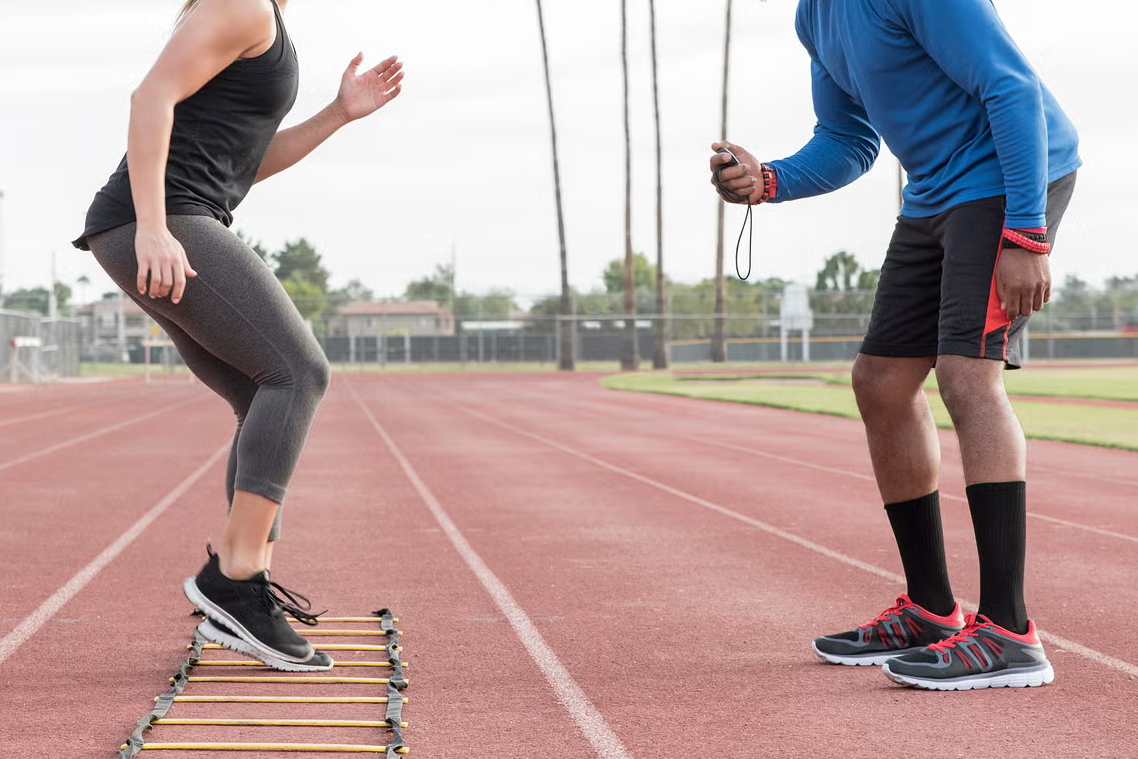
- Agility Ladder Patterns
Use a floor ladder to practice lateral steps, in-and-out movements, and alternating foot placements.
Start slowly enough to complete each sequence accurately. Increase the pace as foot placement and rhythm improve.
Ladder drills help athletes practice movement patterns, but competitive agility also requires reading opponents, responding to cues, and changing direction under unpredictable conditions.
- Cross-Body Movements
Perform controlled movements involving opposite limbs, such as bringing the right knee toward the left elbow before switching sides.
Progress to marching, skipping, or more demanding combinations that require alternating arm and leg movements.
These exercises challenge limb sequencing and work well as part of a dynamic warm-up.
- Lateral Bounds With Controlled Landings
Start on one leg and bound sideways, landing on the opposite foot. Hold the landing briefly before pushing off in the other direction.
Keep the trunk controlled and the landing knee aligned with the foot.
Begin with short distances. As landing control improves, increase the distance or perform consecutive bounds with shorter pauses.
- Cone Movement Patterns
Arrange several cones in a small training area. Move between them using forward runs, lateral shuffles, and controlled changes of direction.
Initially, follow a predetermined route. Once the pattern becomes familiar, have a coach or partner call out the next cone.
The reactive variation requires athletes to interpret a cue, select a direction, and execute the movement without following a memorized sequence.
How to Structure Coordination Training
Coordination drills work best when athletes are fresh enough to maintain precise movement control.
For general practice, two or three short sessions per week can provide a starting point. Sessions of approximately 10 to 20 minutes may fit into a warm-up or a separate skills session, depending on the athlete’s schedule.
A sample 15-minute session could include:
- Three minutes of basic ball-handling or footwork drills.
- Four minutes of hand-eye or eye-foot coordination exercises.
- Four minutes of balance and whole-body movement tasks.
- Four minutes of sport-specific drills involving changing cues or conditions.
These durations are examples rather than fixed requirements.
Beginners should concentrate on controlled execution. Experienced athletes can add greater speed, unpredictable cues, and tasks that combine several movements.
Because fatigue can interfere with technical accuracy, demanding coordination drills often fit better near the beginning of a training session than after exhaustive conditioning.
Coordination vs Balance and Agility
Coordination, balance, and agility contribute to athletic performance, but each describes a different aspect of movement.
Coordination involves organizing and timing muscle activity to perform an intended action. Balance refers to maintaining or recovering postural stability while stationary or moving. It depends on sensory feedback and the nervous system’s regulation of body position. Agility generally describes the ability to change speed or direction in response to a stimulus. It combines physical movement capabilities with perception and decision-making.
Consider a basketball defender reacting to an opponent’s sudden change of direction.
The defender uses coordination to organize footwork, balance to control body position while shifting weight, and agility to recognize the opponent’s movement and respond appropriately.
Another related ability is reaction time, which measures the interval between detecting a stimulus and initiating a response. It does not measure how accurately or effectively the subsequent movement is performed.
These distinctions matter when selecting exercises. A drill that improves balance or rehearsed footwork does not necessarily develop the perceptual and decision-making skills required for competitive agility.
How to Measure and Track Coordination Progress
Coordination includes several abilities, making it difficult to evaluate with a single test. Athletes should choose assessments that reflect the movements they want to improve.
Using consistent equipment, instructions, and scoring methods allows meaningful comparisons between testing sessions.
Hand-Eye Coordination Tests
A timed wall-toss drill can help track catching performance under standardized conditions.
For example, an athlete throws a tennis ball against a wall and catches it with the opposite hand for 30 seconds.
Record the number of successful catches and repeat the test under identical conditions.
Higher scores indicate improvement in that task, although familiarity with the drill and throwing technique can also influence the results.
Balance Assessments
Single-leg stance tests measure how long an athlete can maintain a specified position without losing balance.
More structured assessments, such as the Y-Balance Test, evaluate reaching performance while standing on one leg.
These tests provide information about postural control rather than coordination as a whole. They are most useful when balance is relevant to the athlete’s training goals.
Movement Accuracy and Consistency
Sport-specific assessments can track successful repetitions, target accuracy, or technical errors.
A soccer player might measure the percentage of passes reaching a target from a fixed distance. A basketball player could record successful catches while following a prescribed movement route.
Video analysis can also reveal changes in technique, movement timing, and body positioning that are difficult to identify during practice.
Evaluating Progress
Compare results across several sessions rather than relying on one performance. Fatigue, concentration, and familiarity with an exercise can influence scores, so consistent improvement over time provides a clearer picture of development.
For athletes, the most meaningful sign of progress is better control and consistency in the movements their sport requires.
Introducing new movement requirements or more realistic competitive conditions can help determine whether improved performance extends beyond a familiar drill.
FAQ
Can coordination be improved at any age?
Yes. Children, adults, and older athletes can develop coordination through practice. Improvement depends on previous experience, physical capabilities, training consistency, and the complexity of the skill being learned.
Is coordination more important than strength or speed?
No single physical quality is universally more important. Coordination helps athletes use strength and speed effectively, but performance depends on several interacting abilities. Their relative importance varies between sports and playing positions.
How long does it take to improve coordination?
Athletes may improve at simple drills after several practice sessions. More complex skills can take weeks or months to develop consistently. Previous experience, exercise difficulty, and practice quality influence the rate of progress.
Does juggling improve athletic coordination?
Juggling develops skills involved in tracking objects, catching, and timing hand movements. However, becoming a better juggler does not guarantee improvement in unrelated sports. Athletes should also practice movements that resemble their competitive activities.
What causes poor coordination?
Coordination difficulties may result from fatigue, limited practice, unfamiliar movements, or insufficient development of a motor skill. Vision problems, balance disorders, and neurological or musculoskeletal conditions can also affect movement control. Sudden or unexplained loss of coordination requires medical assessment.